

Insight
State of the Art Monitoring Techniques for Samarco Tailings Dams
18 Jan 2021

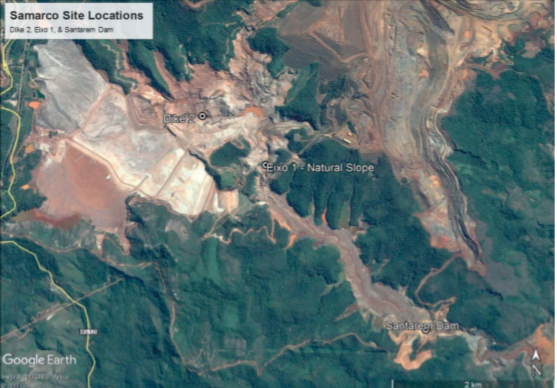
All instruments at Samarco Mine have triggers to prompt appropriate responses dependent on the level of movement detected. The threshold values for radar monitoring, which are summarised in Table I, were selected to allow for greater warning prior to events occurring and based on back-analysis of a minor failure captured in Santarém Dam.
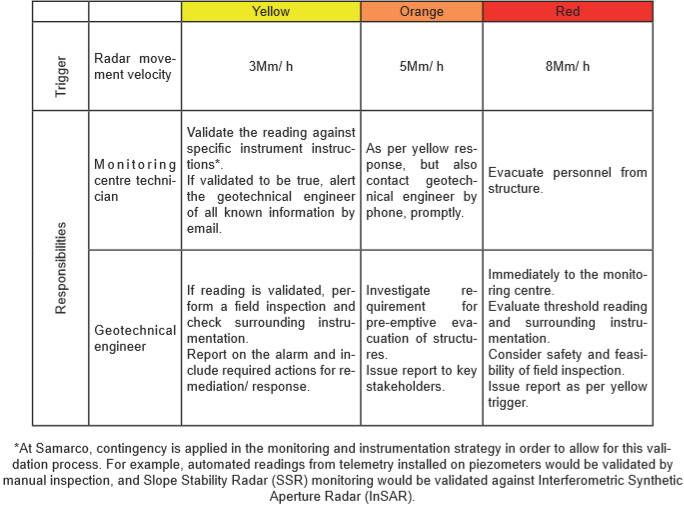
Table 1: Response Plan for Trigger Level. Inclusive of Nominated Radar Movement Thresholds
When averaging observations over time it is important to recognise that a balance needs to be struck between deriving accurate readings and avoiding ‘noise’ in the data by smoothing trends. For this reason, different calculation periods were assessed to establish the sensitivity of the existing thresholds at the Samarco Mine, and their applicability in predicting a failure event. These are represented by “velocity over calculation period” parameters.
Case Study 1 - Santarém Dam
On 12 June 2016, a minor local failure was observed on a spillway area (Figure 2). Material was displaced along a slip plane that formed two thirds of the way up the second bench. In the months preceding, GroundProbe radar surveillance reports documented negligible deformation rates that were not associated with operations, traffic or when correlated against rainfall periods.
The compacted earthfill material exhibited regressive/progressive deformation prior to failure (Figure 3) which can rapidly lead to collapse. This was likely caused by an unusually high amount of rainfall throughout early June.
The existing alarm thresholds were able to predict local failure and successfully provided warnings at five hours, three hours and one hour prior to the failure (Table II), a safe and feasible alarm time for each response type. Lower thresholds would have triggered alarms for longer periods in the preceding days and would present the risk of uneventful alarms in stable conditions.
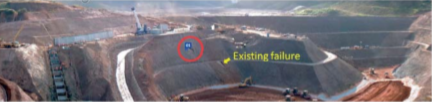
Figure 2: Slope Stability Radar Monitoring for Santarém Dam, Showing Location of Local Failure
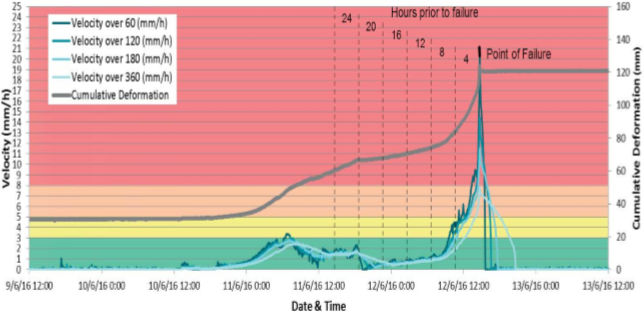
Figure 3: Velocity and Deformation Data Trending for Santarém Dam, Velocity Alarm Thresholds Shown
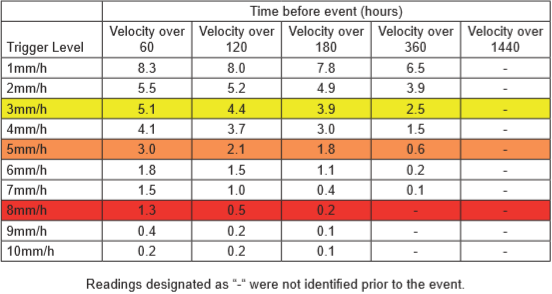
Table 2: Velocity Alarm Assessment for Santarém Dam
Case Study 2 - Dike 2
Between 8 August 2016 and 14 August 2016, a collapse of debris at the toe of Dike 2 was observed. As debris flowed downstream, a progressive failure trend was observed until collapse, with approximately 50% of material deformation occurring on the sixth day of the event. Given a lack of recent rain, the likely cause was upstream runoff resulting in hydraulic forces preferentially degrading a pathway through the material.
Mass collapse of the material may have been observed because of progressive erosion of the surrounding banks driven by decreasing confining stresses and elevated moisture content, which reduced the shear strength of the slimes remaining from the 2015 failure.
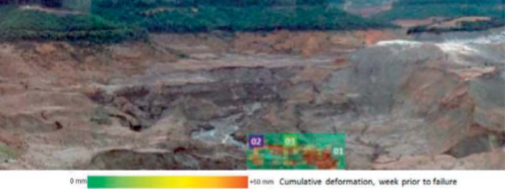
Figure 4: Slope Stability Radar Monitoring for Dike 2, Showing Location of Slimes Collapse
Site thresholds for velocity were effective in predicting the collapse and provided warning 42 hours, 9 hours, and 1.8 hours prior to the event (Figure 5 and Table V)
Unlike Santarém Dam, this failure was observed over several days, which meant the larger calculation periods such as Velocity of 360 and Velocity over 1440 proved most effective in forecasting failure.
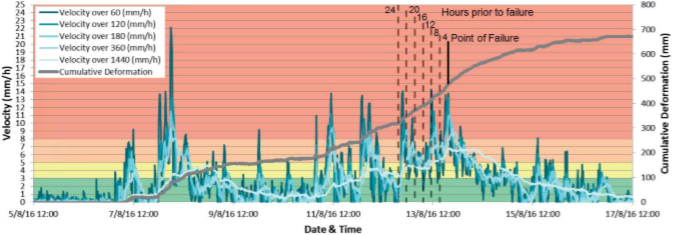
Figure 5: Velocity and Deformation Data Trending for Dike 2, Velocity Alarm Thresholds Shown
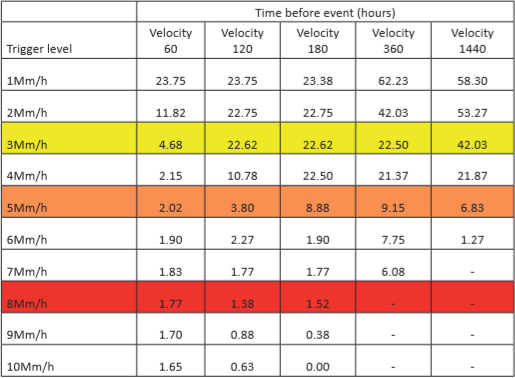
Table 5: Velocity Alarm Assessment for Dike 2
Case Study 3 - Eixo 1 Natural Slope
Dislodgement of material at Eixo 1 natural slope was observed on 14 November 2016 as a result of local, regressive/progressive deformation. The time between deformation being first observed and material failure was 7.5 days.
The slope, comprised of loose rock, was initially intact but anticipated to have weathered and degraded over time. The failure was likely driven by the breakup of the rock at the toe of the slope and an increase in water pressure. Evidence of similar behaviour occurring can be seen in Figure 6.
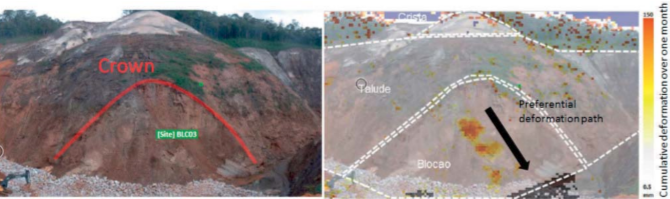
Figure 6: Slope Stability Radar Monitoring for Eixo 1 in November, 2016, Showing Location of Circular Slip Failure
Existing site thresholds for velocity were ineffective at predicting the local failure at Eixo 1. One yellow alarm was triggered thirty minutes prior to failure, however this could be easily brushed over. Alternative metrics are recommended as additional control measures, so an assessment of deformation triggers was conducted (Figure 7 and Table III). Deformation triggers are useful in disaggregating data noise from small deformation data, and hence will present slightly different results than the velocity analysis.
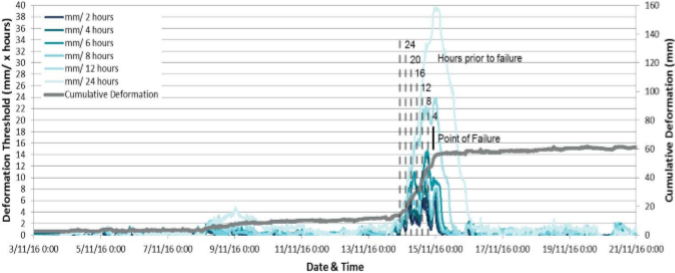
Figure 7: Deformation Data Trending for Eixo 1
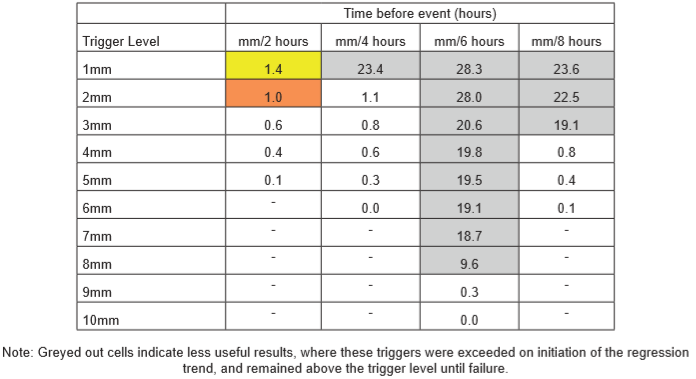
Table 3: Deformation Alarm Assessment for Eixo 1
While the deformation trigger may be appropriate to situations such as Eixo 1, it is also likely alarms will trigger more often and require geotechnical engineering judgement to determine if a risk is credible. It is not cost effective to have real-time solutions operating 24/7 in stable conditions therefore visual observations are recommended as the primary control measure. Operational personnel who are well-trained in geotechnical hazards would be invaluable in detecting risks early.
Implications and Limitations
Existing site thresholds for deformation velocities were effective in predicting two of the three events with adequate warning time. The Eixo 1 failure indicates that there are additional deformation metrics that can be used to increase the likelihood of an event being detected.
It is worth considering whether one conservative trigger value for each threshold applied across the entire site is truly effective for different types of slopes. Engineers also need to consider the impact of unexpected weather conditions.
The intent of the dam monitoring strategy is to assess and measure design expectations against the performance of the dam. It is anticipated that correlation of deformation parameters with other instrumentation readings would be valuable in the development of monitoring strategies. Although monitoring with no history is challenging it is not redundant.
The yellow, orange, and red alarm triggers for radar monitored slope deformation velocities were effective at providing warning for longer duration events however were unsuccessful at predicting short duration events. Alternative methods including deformation assessment are suggested to provide additional prediction measures.
Read More
This article is a summary of the paper State of the Art Monitoring Techniques for Samarco Tailing Dams by L Clarkson, S Carneiro, B de Matos Castilho, D Williams, M Ruest, M Llano and D Noon. The paper was presented at the XIV International Congress on Energy and Mineral Resources in April 2018.